How LinkedIn Can Become Your #1 Lead Generation Channel in 2026
Learn how consultants, coaches, B2B founders, and sales teams are using LinkedIn as their most reliable lead generation channel in 2026. This in-depth guide breaks down data, trends, and practical strategies backed by trusted industry research.
LINKEDIN LEAD GENERATIONLINKEDIN OUTREACH


For many years, LinkedIn was treated as a secondary platform. Something professionals update occasionally, visit when changing jobs, or used to accept connection requests without much thought. That version of LinkedIn no longer exists.
As we move into 2026, LinkedIn has become one of the most reliable and scalable lead generation channels for B2B professionals worldwide. Consultants, coaches, founders, and B2B sales teams are now using LinkedIn not only to build visibility, but to create predictable, conversation-driven pipelines that compound over time.
What makes this shift interesting is that it did not happen because LinkedIn became more aggressive or sales-focused. It happened because buyer behavior changed. People became more selective about who they engage with, more cautious about ads, and more responsive to platforms that allow context, identity, and trust to exist in one place.
Over the last few years, I have spoken with many professionals who initially believed LinkedIn had “stopped working.” In almost every case, the issue was not the platform. It was the approach. Most were using tactics that might have worked years ago, but no longer match how professionals want to communicate today.
This article explores why LinkedIn works so well as a lead generation channel heading into 2026, what trusted data from established sources shows, how LinkedIn compares to other channels, and how professionals can realistically leverage it without resorting to spam, automation abuse, or aggressive selling.
Why LinkedIn Is Fundamentally Different From Other Platforms
Most marketing channels rely on interruption.
Ads interrupt browsing.
Cold emails interrupt inboxes.
Social media posts interrupt entertainment.
LinkedIn operates in a different psychological environment.
People open LinkedIn with professional intent. They are usually thinking about work, growth, challenges, or opportunities. They are not looking to be entertained or distracted. They are open to learning, evaluating ideas, and sometimes even starting conversations.
This difference in mindset changes everything.
According to data published by Sprout Social, 89 percent of B2B marketers use LinkedIn for lead generation, and 62 percent report that it consistently produces leads for their business. That level of adoption is not driven by experimentation or trends. Outcomes drive it.
What often gets overlooked is how this professional mindset affects message reception. A message on LinkedIn is read very differently from a message in a personal inbox or on a consumer social platform. Context shapes trust, and LinkedIn provides context by default.
The Data Behind LinkedIn’s Lead Generation Effectiveness
When evaluating any lead generation channel, opinions matter far less than evidence. Over the past several years, multiple established platforms have consistently reported LinkedIn’s strong performance in B2B environments.
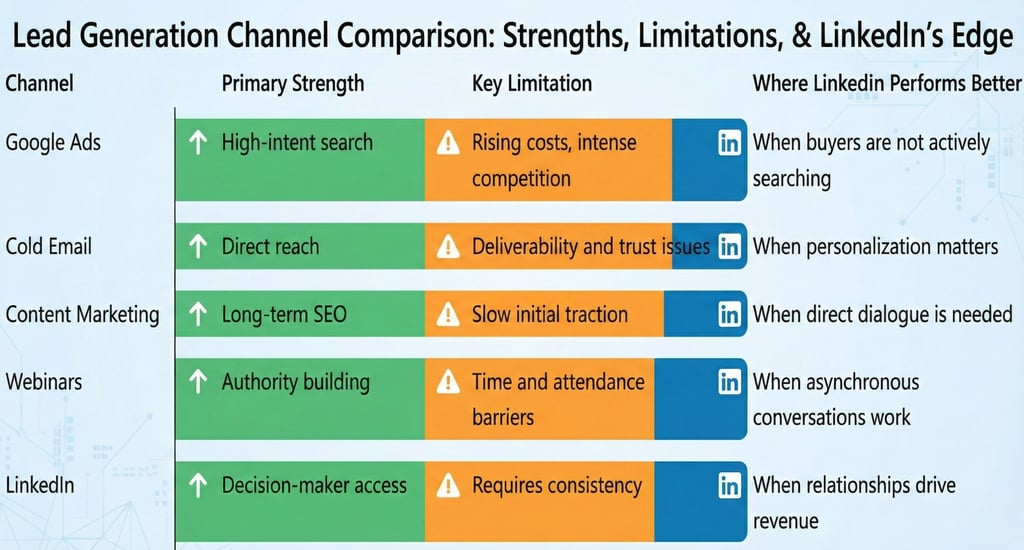
Research referenced by LinkedIn Marketing Solutions, drawing on HubSpot data, shows that LinkedIn is 277 percent more effective at generating leads than Facebook and Twitter combined for B2B marketers. This is especially true for services with longer sales cycles and higher trust requirements.
This effectiveness gap exists because LinkedIn combines three critical elements in one place:
Verified professional identity
Clear business context
Direct access to decision-makers
Unlike anonymous platforms, LinkedIn conversations start with transparency. You know who you are speaking to, what they do, and where they work. That alone removes a major friction point in B2B sales.
Why LinkedIn Continues to Strengthen Instead of Declining
Many digital platforms experience a rise followed by a gradual decline as attention fragments. LinkedIn has followed a different path by focusing on engagement depth rather than entertainment volume.
As reported by Reuters, LinkedIn saw a 20 percent year-over-year increase in video uploads and a 36 percent increase in video views. More importantly, comments and meaningful interactions also increased.
These metrics matter because comments indicate thinking, not scrolling. When people comment, they are investing attention and opinion. That is a strong signal of platform health.
Analysis shared by Hootsuite further shows that LinkedIn users tend to engage more deeply with professional content than users on most other social platforms.
In practical terms, LinkedIn remains one of the few digital environments where attention has not been completely diluted.
Why LinkedIn Works Especially Well for Consultants and Coaches
Consultants and coaches operate in trust-based markets. Their services are often high-consideration, outcome-focused, and relationship-driven. These are not impulse purchases.
LinkedIn aligns naturally with this model.
Instead of pitching immediately, consultants can:
Demonstrate expertise through profile positioning
Engage in relevant conversations
Share insights without pressure
Build familiarity over time
Many consultants I have interacted with say the turning point came when they stopped trying to sell on LinkedIn and started treating it like a long-term relationship channel. Once conversations became more natural and less transactional, response quality improved noticeably.
This is one of the main reasons LinkedIn often outperforms paid ads for consultants. The platform allows them to build trust before asking for attention.
Why B2B Founders and Sales Teams Benefit Disproportionately
For B2B founders and sales teams, LinkedIn provides something increasingly rare: direct access to decision-makers with context.
Instead of guessing who to contact, LinkedIn allows targeting by:
Role and seniority
Industry and company size
Geography and growth stage
Sales conversations that start on LinkedIn tend to feel warmer because the recipient can see who is reaching out and why. A profile provides instant background, credibility, and intent.
This does not mean every conversation converts. It means conversations start on a more honest footing.
Trust as the Core Engine of LinkedIn Lead Generation
Before replying to a LinkedIn message, most professionals follow the same pattern. They check the sender’s profile.
They scan:
The headline for clarity
The About section for positioning
Experience for credibility
Recent activity for authenticity
It is interesting how consistent this behavior is across industries and regions. Even when a message is well written, a vague or confusing profile often stops the conversation quietly.
This is why LinkedIn lead generation is not a single tactic. It is an ecosystem of trust signals.
Without trust, outreach fails.
Without clarity, trust never forms.
A Practical LinkedIn Lead Generation Framework That Scales
1. Positioning Your Profile as a Trust Page
A strong LinkedIn profile should quickly answer:
Who you help
What problem do you solve
Why someone should trust you
Profiles that focus on clarity consistently outperform profiles that focus only on titles or credentials.
2. Targeting With Precision
Effective LinkedIn lead generation starts with understanding:
Your ideal customer profile
Their real challenges
Why LinkedIn is relevant to them
Random outreach produces random results. Focused outreach produces conversations.
3. Leading With Curiosity
The goal of LinkedIn outreach is not immediate conversion. The goal is to start a meaningful conversation.
Short, relevant, human messages consistently outperform long pitches and automation-heavy sequences.
LinkedIn Demographics and Audience Quality
Audience quality matters more than audience size.
According to demographic analysis published by Hootsuite, approximately 47 percent of LinkedIn users fall into the 25 to 34 age group, around 28 percent are aged 18 to 24, and roughly 20 percent are aged 35 to 54.
This concentration explains why LinkedIn performs especially well for:
B2B services
Consulting and advisory roles
Leadership and management offerings
Sales and strategy teams
Visual placement suggestion: Insert a demographic bar chart here. Source: Hootsuite.
LinkedIn as a Long-Term Asset
Unlike ads, LinkedIn assets compound over time.
Your profile gains authority.
Your network becomes warmer.
Past conversations reopen doors.
Content continues to attract attention.
A conversation started today may convert months later. This is why LinkedIn should be viewed as a relationship engine, not a campaign tool.
A common mistake is expecting LinkedIn to behave like a short-term tactic. In reality, it behaves like a professional ecosystem. Those who approach it with patience tend to get far more value over time.
The Myth of LinkedIn Saturation
LinkedIn is not saturated with quality. It is saturated with poor execution.
Generic messages, rushed pitches, and over-automation create the illusion that LinkedIn no longer works. In practice, these tactics simply stopped working.
Professionals who focus on relevance, clarity, and respectful communication continue to see strong results.
What LinkedIn Lead Generation Will Look Like in 2026
Looking ahead, several patterns are becoming clear:
Personal branding will matter more than automation
AI will support research and personalization, not replace conversations
Quality interactions will outperform high-volume campaigns
Trust signals will outweigh tactics
LinkedIn will continue to reward professionals who respect attention and communicate clearly.
Final Thoughts
LinkedIn has evolved far beyond networking. As we move into 2026, it stands as one of the most effective lead generation channels for B2B professionals globally.
For consultants, coaches, founders, and sales teams willing to invest in clarity, consistency, and conversation, LinkedIn offers something increasingly rare in modern marketing: direct access to the right people, in the right context, with trust built in.
Contact
Ready to grow? Let’s start a real conversation.
© 2026 Growth On LinkedIn. Operated by John Paul. All rights reserved.
Your email stays private. Unsubscribe anytime.