Is your profile costing you leads? Get a 9-point professional audit and rewrite. No calls needed.
How to Turn LinkedIn Followers Into Paying Clients
Having thousands of followers means nothing if none of them are paying you. This post gets into the real reason LinkedIn audiences don't convert and walks you through the practical steps to change that, from warming up the right people to making your first offer easy to say yes to.
LINKEDIN OUTREACHLINKEDIN LEAD GENERATION
John Paul
3/18/20266 min read
The Gap Nobody Talks About
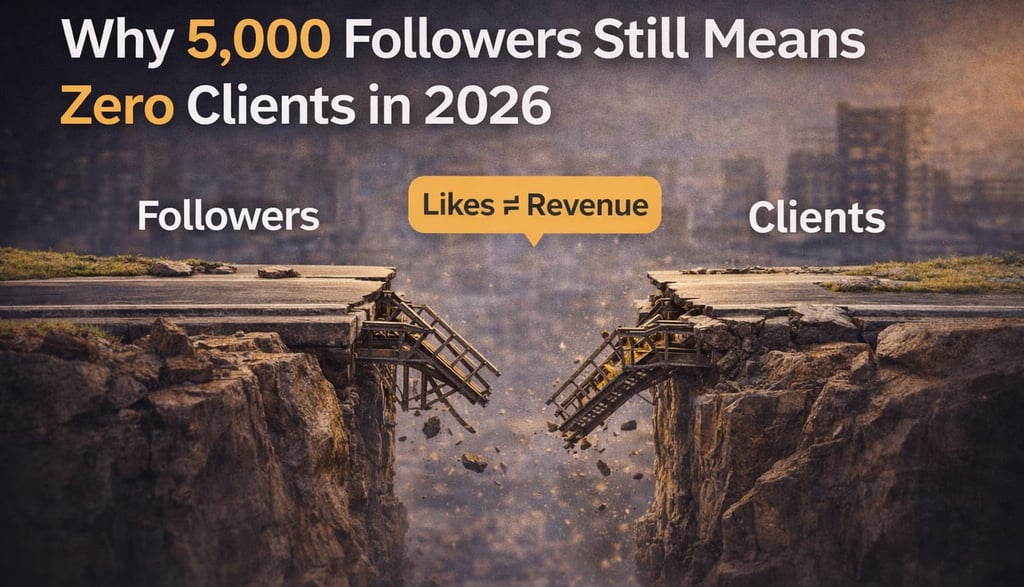
You can have 5,000 followers, post consistently, get good engagement, and still have zero clients coming from LinkedIn. This is more common than people admit. Likes are not pipeline. Followers are not revenue. And in 2026, with content output at an all-time high thanks to AI, the gap between 'building an audience' and 'building a business' has never been wider.
The people who are converting their LinkedIn audience into clients are not necessarily the ones with the most followers or the best content. They are the ones who understand that LinkedIn is a conversation platform, not a broadcast platform. Content gets you visible. Conversations get you clients.
This article is about the moves you make after someone starts following you, engaging with your content, or responding to your outreach.
Why Converting Followers Feels Hard in 2026
Three things are working against you right now that were not as strong a few years ago:
• Content fatigue is real. People are consuming more LinkedIn content than ever but trusting it less. When every other post is polished and AI-assisted, the ones that convert are the ones that feel genuinely human and specific.
• The path from follower to client is not automatic. LinkedIn does not have a built-in funnel. You have to create your own, intentionally.
• Decision-making timelines are longer. In uncertain economic conditions, people are more careful about who they hire. They are watching for longer before they reach out.
The good news is that all three of these challenges have a common solution: specificity and proactive relationship building. Let me show you what that looks like in practice.
Step 1: Know Who Your Followers Actually Are
Most people never look at who is following them. They post and hope. Before anything else, go through your recent followers and engagers and segment them roughly into three buckets:
• Ideal clients: People who match your ICP, have the right title, company size, or challenge.
• Referral sources: People who may not need your services but know people who do.
• Everyone else: Engaged but not a commercial fit right now.
Your energy goes to bucket one first, then bucket two. This is where the revenue is. Everyone else gets a like or a reply to their comment, but you are not building a deliberate relationship there.
Step 2: Warm Up Before You Reach Out
The biggest mistake people make is going from 'this person liked my post' to 'sending them a DM pitch' with nothing in between. That gap kills conversions. You need a warming period.
Here is a simple warming process that takes less than five minutes per person and makes a significant difference:
• Like or react to one of their recent posts.
• Leave a specific, thoughtful comment that adds something to the conversation. Not 'great post' but an actual insight or question.
• Repeat once or twice over the next week or two.
• Then send your connection request or DM.
By the time you reach out directly, they have seen your name twice. You are warm, not cold. Your message feels like the natural next step in a conversation that already started.
Step 3: The First DM After Someone Engages
When someone consistently engages with your content, that is a signal. Do not ignore it. But also do not turn it into a pitch. Your first message should acknowledge the engagement in a natural way and open a dialogue.
TEMPLATE
Hi [Name],
Noticed you have been engaging with a few of my posts on [topic]. Appreciate it. Curious whether [the problem your content addresses] is something you are actively working on, or more something you are tracking for now?
Either way, happy to be a resource if it is ever useful.
[Your name]
This message does three things. It acknowledges them personally. It asks a question that invites a real conversation rather than a yes or no. And it positions you as someone helpful rather than someone selling.
Step 4: The Content That Creates Conversations, Not Just Views
If you want your content to drive pipeline, you need to shift from 'informational posts' to 'conversation-starting posts.' These are not the same thing.
Informational posts teach. People read them, learn something, and scroll on. Conversation-starting posts create a reason for people to engage or respond directly to you.
Examples of content that creates conversations:
1. Sharing a specific result you got for a client (with their permission), and ending with 'happy to share the process if it is useful to anyone here.'
2. Posting a contrarian opinion about something your ideal clients believe and inviting pushback. Disagreement drives comments. Comments drive visibility.
3. Asking a direct question to your audience about a challenge you know they face. 'What is the single biggest obstacle you are hitting with X right now?' People answer these.
4. Sharing a lesson you learned the hard way. Vulnerability in a professional context is still rare enough to stop the scroll.
In 2026, with AI generating endless polished tips and listicles, the content that converts is personal, specific, and honest. There is no AI that can replicate your actual experience and perspective. Use that.
Step 5: Creating an Offer That Is Easy to Say Yes To
A lot of people lose the conversion not because they did not nurture the relationship well, but because their offer is too big, too vague, or too scary as a first step.
The highest-converting LinkedIn offers right now have three things in common: they are low commitment, they deliver something specific, and they are easy to act on immediately.
Instead of 'book a discovery call,' try something like:
1. 'I can send you a quick audit of how your current LinkedIn presence is performing against your goals. Takes me about 15 minutes, no charge.'
2. 'Happy to share the exact framework we used for [result]. Would that be a useful starting point?'
3. 'I do a 20-minute no-agenda call where I show you what has been working for businesses similar to yours. Interested?
The goal of the first offer is not to close a deal. It is to get them on a call or into a conversation where the deal can happen. Lower the barrier to that first step as much as possible.
Step 6: The Follow-Up That Keeps the Relationship Warm
Not every follower who fits your ICP is ready to buy right now. Some of them are six months away from being ready. If you only reach out once and move on, you lose them to whoever reaches out when they are ready.
Build a simple system for staying visible to your warm list:
• Keep a small list of 20-50 people you are deliberately building a relationship with.
• Engage with their content regularly. Not every post, but consistently.
• Every 6-8 weeks, send a short personal check-in with no agenda. Share something relevant, ask how things are going, or reference something they posted.
• When they share news, a promotion, a new role, or a win, acknowledge it. A quick congratulations goes further than most people realize.
This is not a CRM workflow. It is relationship maintenance. The difference is that it actually feels genuine because it is.
What AI Changes About This in 2026
AI has made content creation easier for everyone, which means the content itself is now table stakes. What AI cannot do is build trust over time with specific individuals. It cannot notice that someone just posted about a challenge and reach out with something genuinely useful. It cannot make someone feel like they matter to you.
The people winning on LinkedIn in 2026 are using AI to handle the repetitive parts, things like drafting initial outreach, repurposing content, or analyzing what posts performed best. But they are doing the relationship work themselves. That human layer is the competitive advantage that AI cannot commoditize.
Putting It Together: A Simple Weekly Routine
You do not need hours a day to make this work. A focused 45-60 minutes a week is enough if you spend it on the right things:
1. 15 minutes: Identify and warm 5 new ideal followers or engagers.
2. 15 minutes: Send 3-5 personal follow-up or check-in messages to your warm list.
3. 15 minutes: Reply to every comment on your recent posts and start real conversations in the replies.
4. 10 minutes: Review who engaged this week and decide who moves into active relationship building.
That is it. Content creation is separate. These 45-60 minutes are purely relationship and conversion activity. Do this consistently for 90 days and your LinkedIn will feel completely different.
The Bottom Line
Followers become clients when they trust you, when the timing is right, and when the first step to working with you is easy enough to say yes to. Your job is to stay visible, be genuinely useful, and make it easy to say yes when they are ready.
In a world where AI is doing most of the outreach and most of the content, the people who are building real relationships manually have a massive, quiet advantage. Be one of those people.
Contact
Ready to grow? Let’s start a real conversation.
© 2026 Growth On LinkedIn. Operated by John Paul. All rights reserved.
Your email stays private. Unsubscribe anytime.