
Here is what nobody talks about when they say "just personalize your connection requests." In 2025 and into 2026, LinkedIn inboxes are flooded with AI-generated messages. People can feel it. The moment a message starts with "I came across your profile and was impressed by your work," the reader already knows a bot wrote it. They do not even finish reading.
So the real problem is not that people are lazy with their requests. The problem is that even the people who are trying to personalize are still following templates that have become so widely used, they have lost all meaning.
In 2026, getting a connection request accepted comes down to one thing: making the other person feel like a real human wrote it, in a moment, specifically for them. That is it. Everything else is noise.
What Changed in 2025 That Still Matters in 2026
A few things shifted on LinkedIn in 2025 that changed how connection requests land:
LinkedIn started showing connection request previews in notifications. Your opening line is visible before someone even clicks accept. You essentially have one sentence to make someone curious enough to read on.
Acceptance rates dropped industry-wide. According to several social selling reports from 2025, cold connection acceptance rates fell to around 20 to 28 percent on average going into 2026. The bar for what feels genuine went way up.
AI detection is now instinctive, not logical. People do not consciously think "this was written by AI." They just feel something is off and ignore it. You cannot trick your way out of this. You have to actually write like a person.
The 3 Types of Connection Requests That Work in 2026
1. The Observation Request
This works when you have genuinely noticed something about the person. A post they wrote, a comment they left, a company announcement, or even just their job title and location combination that gives you something specific to reference.
"Hi [Name],
Saw your post about [specific topic] and it actually made me think differently about [aspect]. I work with [brief description of what you do] and would love to stay connected.
[Your name]"
Why it works: It proves you were paying attention. It is short. It makes the other person feel seen, not sold to. And it gives them a reason to accept that has nothing to do with a pitch.
2. The Mutual Ground Request
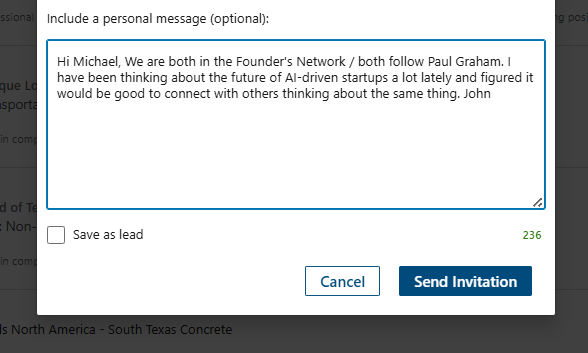
This one works when you share a group, attended the same event, or both follow or engage with the same person or topic. You are not cold, you are adjacent.
"Hi [Name],
We are both in [group name] / both follow [person's name]. I have been thinking about [related topic] a lot lately and figured it would be good to connect with others thinking about the same thing.
[Your name]"
The key here is that you are positioning yourself as a peer, not a vendor. You are not asking for anything. You are just showing up as someone interested in the same things they are.
3. The Direct and Honest Request
This one is underrated. In an era of fake personalization, being refreshingly direct actually stands out.
"Hi [Name],
I help [type of person] with [problem you solve]. Your profile came up and I thought it was worth reaching out directly rather than pretending I have a deeper reason. Happy to connect if that world is relevant to you.
[Your name]"
This works because it respects the person's intelligence. You are not pretending. You are being straight with them, and in 2026, that is rare enough to be noticed.
Important warning: This template only works if your targeting is precise. If you send a direct "I help [X] solve [Y]" message to someone who does not actually have that problem, it will land as spam regardless of how honest the tone is. Make sure you have confirmed this person genuinely fits who you help before using this one.
What to Avoid (Most People Still Do This)
Starting with "I came across your profile" -- it is the most flagged phrase in AI-detection instincts right now.
Mentioning their company name in the first sentence as if that counts as personalization.
Writing more than 4 to 5 lines. People skim notifications.
Using phrases like "synergies," "mutual benefit," or "explore potential opportunities." These are red flags.
Closing with "Looking forward to connecting!" or "Looking forward to exploring synergies!" Both sound automated. Instead close with something simple like "Thanks, talk soon" or just your name.
Sending a great message from a poorly optimized profile. Your message opens the door but your profile is what makes them walk through it. If your headline is vague, your photo is missing, or your About section reads like a job description, your acceptance rate will stay low no matter how good the message is. Fix the profile first.
A Note on Using AI to Write Your Connection Requests
Yes, you can use AI to help draft your outreach. But the mistake people make is copying the AI output directly. Use AI to get a first draft, then rewrite the whole thing in your own voice. Add a detail only you would know. Cut the fluff. Read it out loud. If it sounds like something a LinkedIn automation tool would generate, rewrite it.
The goal is not to sound like a human to avoid detection. The goal is to actually be a human reaching out to another human. There is a difference, and people feel it.
Quick Checklist Before You Send
Is the first line specific to this person, not just their job title?
Does the message stay under 5 lines?
Have you removed all corporate buzzwords?
Does it sound like something you would actually say out loud?
Are you asking for anything in the connection request itself? If yes, delete it.
Does your own profile look credible enough that someone would want to connect back?
Connection requests are not the place to pitch. They are the place to open a door. Keep them short, specific, and human. Do that consistently, and your acceptance rate will go up.
Once they accept, the next challenge is following up without being annoying. Read the next post: LinkedIn Cold Outreach Follow-Up Sequences: How to Follow Up Without Being Annoying
Contact
Ready to grow? Let’s start a real conversation.
© 2026 Growth On LinkedIn. Operated by John Paul. All rights reserved.
Your email stays private. Unsubscribe anytime.