Is your profile costing you leads? Get a 9-point professional audit and rewrite. No calls needed.

LinkedIn Cold Outreach Follow-Up Sequences: How to Follow Up Without Being Annoying
Most LinkedIn follow-ups get ignored because they feel like follow-ups. Here's how to structure a sequence that keeps the conversation moving without coming across as desperate.
LINKEDIN OUTREACHLINKEDIN LEAD GENERATION
John Paul
3/3/20264 min read
The Follow-Up Problem Nobody Wants to Admit
Most people either give up after one message or follow up so aggressively they get blocked. There is almost no middle ground in the wild, and that is a huge missed opportunity.
The truth is, a lot of deals happen on message 3 or 4. Not because the person was not interested earlier, but because life got in the way, or the first message was not quite right, or they just needed to see your name twice more before they trusted you enough to reply. Follow-ups work. The way most people do them does not.
In 2026, with AI flooding inboxes, the rules around follow-up have shifted. What felt mildly pushy in 2023 now feels hostile. What feels warm and patient today gets responses.
What Changed in 2025 That You Need to Know
LinkedIn rolled out clearer spam filters and message quality signals in 2025. Accounts that send high volumes of unanswered follow-ups started seeing their InMail credits reduced and reach limited. This pushed everyone toward quality over quantity, and it rewards people who write follow-ups that feel like they belong in a conversation, not a CRM sequence.
The second big shift is that buyers got smarter about sequences. If your follow-up message sounds like step 2 in an automated cadence, they know it. Phrases like 'Just circling back,' 'I wanted to bump this up in your inbox,' and 'Did you get a chance to see my last message?' have become the universal signal that you are running an automated sequence and they are just a name in a spreadsheet.
The Right Mindset for Follow-Ups in 2026
Think of your follow-up sequence less like a sales cadence and more like a conversation you are keeping warm over time. You are not chasing. You are staying visible, adding value, and making it easy for them to respond when the time is right for them.
This means each follow-up should either offer something new, say something different, or take a completely different angle. It should never just be a reminder that you exist.
A 4-Message Sequence That Works Right Now
Message 1: The Opening (Day 1)
Your first message should be short, relevant, and end with an easy question or no question at all. Do not pitch in message 1. Start a conversation.
TEMPLATE
Hi [Name],
I work with [type of business] on [specific problem you solve]. Noticed you are focused on [something from their profile or recent activity] and thought it might be worth a conversation.
Happy to share what has been working if that is ever useful.
[Your name]
Message 2: The Value Add (Day 5-7)
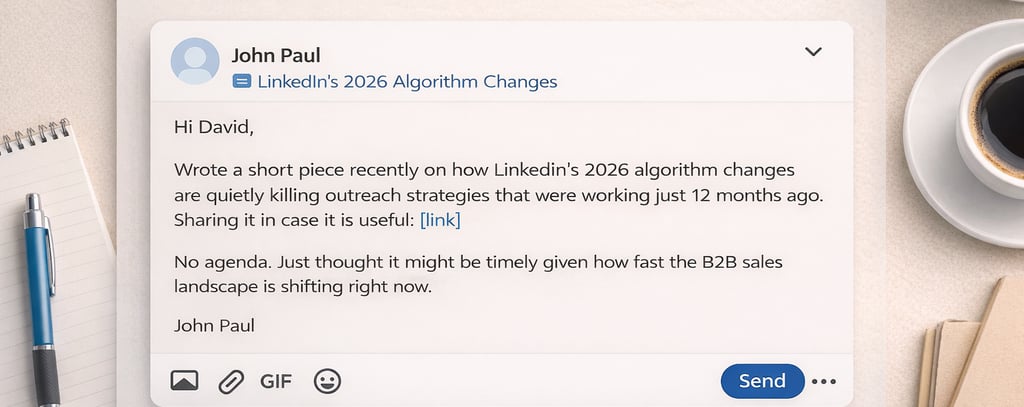
Do not reference your first message. Just show up with something useful. A short insight, a link to a post you wrote, or a question that is relevant to something happening in their world.
TEMPLATE
Hi [Name],
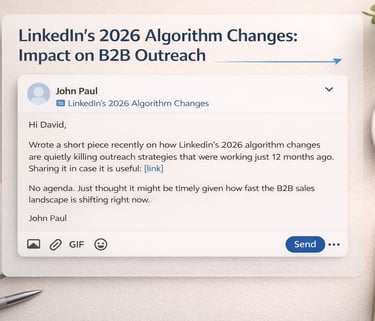
Wrote a short piece recently on [topic directly relevant to them]. Sharing it in case it is useful: [link]
No agenda. Just thought it might be timely given what is happening in [their space].
[Your name]
This message works because it gives before it asks. It also proves you are paying attention to their world, not just thinking about your own pipeline.
Message 3: The Direct Ask (Day 12-14)
By now you have shown up twice with value and no pressure. Message 3 is where you can be more direct, but framed as an easy option for them, not a demand.
TEMPLATE
Hi [Name],
I have reached out a couple of times now, so I will be upfront. I think there could be a good fit here and I would love 20 minutes to share what we have been doing with [relevant type of business].
If the timing is not right, totally fine. Would love to stay connected either way.
[Your name]
The transparency here is the asset. You are not pretending this is your first time reaching out. You are owning the follow-up, and that honesty disarms people.
Message 4: The Clean Goodbye (Day 21-25)
This is your last message in the sequence. Its job is to close the loop gracefully and leave the door wide open for them to come back later on their terms.
TEMPLATE
Hi [Name],
I will leave this here. I know timing is everything and this may simply not be the right moment.
If things change or [problem you solve] ever becomes a priority, you know where to find me. Happy to pick it up whenever.
[Your name]
This message works for two reasons. First, people respect the closure. Second, it often triggers a reply from people who were meaning to get back to you but kept forgetting. The 'last message' creates a small urgency that the earlier ones did not.
Spacing and Timing
Four messages spread over 21-25 days is a respectful cadence. Anything faster feels desperate. Anything slower loses momentum. The spacing also matters: do not follow up on weekends and avoid Mondays before 10am and Fridays after 3pm. Tuesday through Thursday mid-morning tends to get the best response rates.
What to Do If Someone Views Your Message But Does Not Reply
Nothing. Do not follow up specifically about the fact that they read your message. That feels like surveillance. Just continue with your normal sequence timing as if you do not know they opened it. Bringing up read receipts makes people uncomfortable and signals that you are watching too closely.
The Role of AI in Your Follow-Up Sequences in 2026
AI tools are useful for drafting and varying your messages so they do not sound repetitive. But the mistake people make is letting the AI run the whole sequence without human review. Before anything goes out, read it out loud. If it sounds like a chatbot wrote it, rewrite it. Your job is to write like a person who genuinely wants to help, not like a system running a contact workflow.
One thing AI is genuinely good for: analyzing which of your past messages got replies and identifying patterns. Use it as a research tool, not a ghostwriter you leave unsupervised.
The One Rule That Makes Everything Else Work
If you would not send that message to a friend you had not spoken to in a while, do not send it to a prospect. That is the filter. Every follow-up should pass that test. When it does, you stop being annoying and start being someone worth responding to.
Contact
Ready to grow? Let’s start a real conversation.
© 2026 Growth On LinkedIn. Operated by John Paul. All rights reserved.
Your email stays private. Unsubscribe anytime.